Thursday, July 10, 2014

Reading Like Writers Mini Lesson

This is a Writer's Workshop mini lesson using the mentor text Sleepy Bears by Mem Fox.  We are in the middle of our How to Read Like Writers unit from About the Authors by Katie Wood Ray.  During this lesson I am trying to get the students to notice what writers do (craft) as they are reading.  This helps tie what we are learning in Writer's Workshop to what we are learning in reading and how they can use during our Daily 5 rounds.

You may be getting tired of the same text for all these lessons...but I am trying to prove a point.  One amazing text can be used for so many different focus skills.


One of my references in this video is to an anchor chart that I have hung up from a previous reading lesson on Good Readers are Good Thinkers.  I also mention moving our writing from a 2 or 3.  This refers to the writing continuum our district has adopted.  Both of these comes from Norma Jackson.  She is another amazing resource for writing.  If you haven't looked into her work, take the time to do that soon.  I have been blessed to not only attend her workshops, but also meet with her for guidance.  My district has been so wonderful to fund that collaboration.  This has helped me as both a writing teacher and a reading teacher because so much of what she has works for both.  Seriously, check out Norma Jackson and About the Authors by Katie Wood Ray if you haven't yet.

Tuesday, July 8, 2014

Inferring Follow Up Lesson

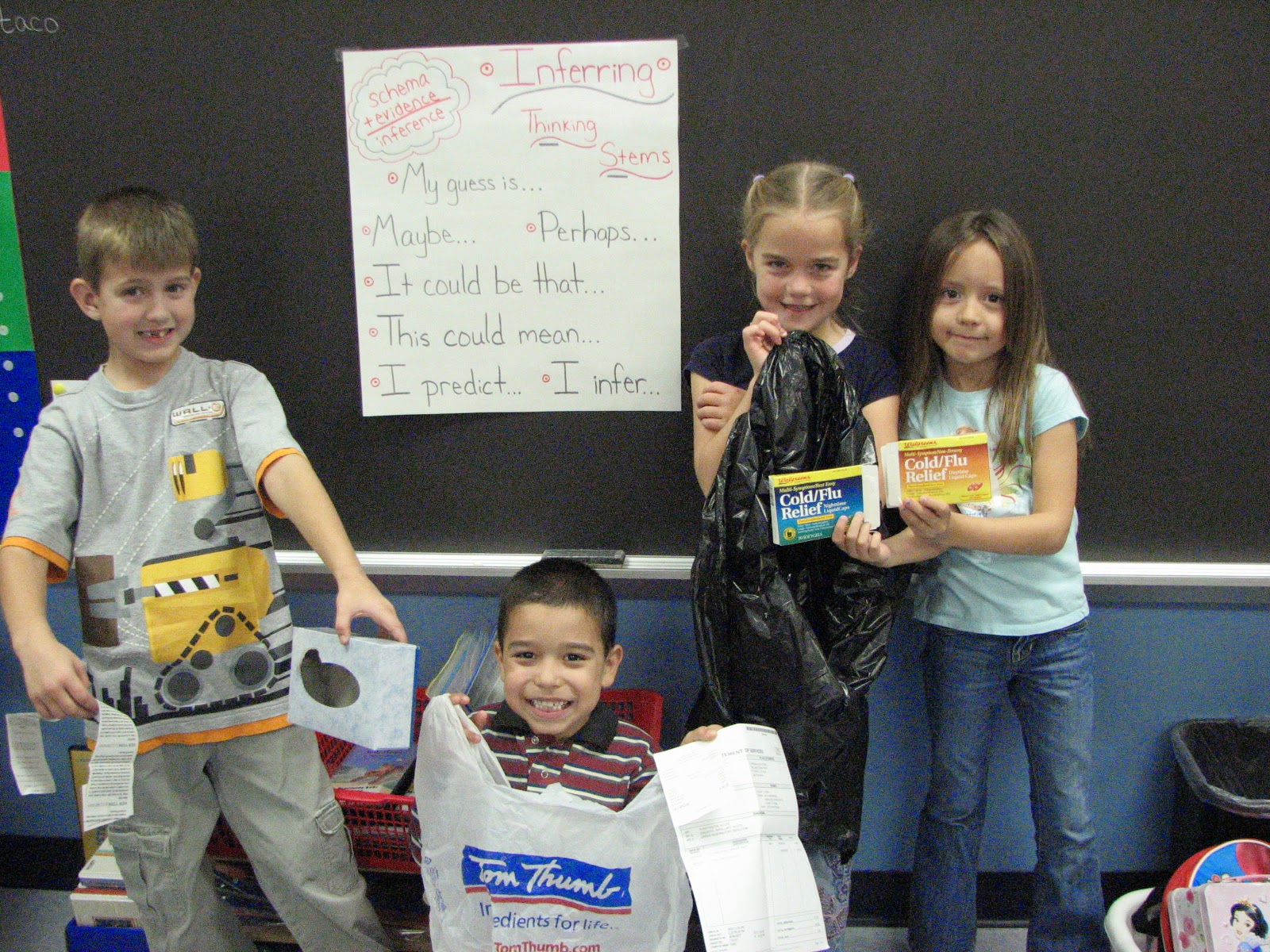
After you have taught an introduction lesson to inferring (I use the garbage bag lesson) you want to make sure that you do several follow up lessons to clear up any misconceptions about the strategy.  One of the common mistakes I notice first graders make when they infer is just saying anything and calling it an inference.  A few years ago I went to a conference and Margaret Kilgo said that you can't let kids think that their 'schema' trumps evidence.  Later on when they get to those high stakes test they think that any schema they have will also match the character and it can be devastating to the thinking and answering.  That makes sense...as I noticed my students that year trying to use inferring I realized what a problem that could be.  The best solution to this is to teach from the beginning that there has to be text evidence to support an inference.
 
This is a lesson I presented this year to my student to try and help.  Please forgive the poodle skirt...it was the 50th day of school. 


Please note that I did not read the text in this lesson.  We were using Sleepy Bears by Mem Fox which is one of our writing mentor texts.  I had read it several times during the week and we had looked at various text features.  One of the best things I have EVER learned as a teacher is to use good mentor texts.  Then you can squeeze tons of learning out of one text without having to read a book for every strategy you use.  I love to read new books, but we are working with short attention spans.  If you look at trying to get in and get out with a focus lesson then you can't take the time to read a new book with every single lesson.

Monday, July 7, 2014

Comprehension Strategy Pictures

I was looking through some old pictures and noticed something I used to do as a teacher and then quit.  You always think of yourself as getting better...but sometimes as you look back you notice you have let some things slip.  This is something I used to do but stopped in order to 'keep up' - ha!  Like that ever happens!  So I'm bringing it back.  

Kids love pictures of themselves.  LOVE.  So one of the ways I use that to my advantage is to take pictures of kids doing something the right way.  You would be amazed how quickly everyone in your class is picture perfect when they notice the camera around.  I also use the love of pictures to help reinforce reading strategies that we have learned.  

If you haven't read Comprehension Connections by Tanny McGregor then go buy it now!  Seriously. Amazing!  I use a lot of her ideas for introduction lessons and anchor charts.  As the years have gone on I have tweaked the lessons for myself.  But she is the basis of how I teach reading comprehension.  

I strongly believe in the gradual release of responsibility model in all my teaching.  If you aren't familiar with it then I would look it up.  But basically it reminds me that I can't expect the kids to just know how to do something after one lesson.  Sounds like common sense but I used to get so frustrated when kids didn't get 'it' after one or two lessons.  The GRR model basically says the teacher models while students watch and learn.  The next step is the teacher models but gets student help and input.  Then the teacher begins to let the students do more work while she monitors that they are doing it accurately.  The goal is then for the students to use the strategy independently.  For some things the GRR model takes a few lessons, sometimes a few days, and sometimes weeks.  But it reminds me that I have to have done a good job teaching it / modeling it / training it before I ever expect my students to do it.  And then to be okay with guiding them as they first try it.  It's not going to be perfect all the time.  I have to be okay with their approximations as they learn it.  Okay...off my GRR rant.

GRR = I do, we do, you do

So when I have finished the teaching / modeling part of the GRR model and want the students to start trying it, then I choose a few kids to 'model' the mini lessons.  You will recognize the anchor charts and focus lesson components from Comprehension Connections if you have read it.  I post these pictures on the class website and around the room.  You would be amazed at how many kids go home and tell their parents about these strategies when they know they or their friends are in the picture. 


Metacognition - this one has the 'real' reading salad with text and thinking cards


Officially this goes with metacognition.  It's the thought bubble for modeling thinking while you read...always a class favorite!


Schema - lint roller example and a book about an apple orchard (we went on a field trip to one that year so we had schema for it)


Inferring - mystery neighbor garbage bag lesson


Questioning


Visualization - no anchor chart for some reason but they have the suntan lotion and their mental images drawn

So my goal next year is to take pictures after we have learned a strategy.  I want to use the love of pictures of themselves to help make my teaching stick.  Btw - these kids are going to be 6th graders next year...gah!  I'm getting old...


Saturday, July 5, 2014

It's about relationships!

This past year was EXTREMELY difficult and I find myself trying to piece together what I should learn from it. One of the main things I notice as I look back at this year is that when all else was failing – the students and I were still succeeding and enjoying school. A lot of things about the school were different and not always in a good way. But I found myself remembering that I am here because of the sweet (and wild and crazy) little kids in my room. I teach because of the students!


While transferring my year’s pictures into my backup storage I found these pictures. They just made me smile. I love that at the bottom of a spelling test a student spontaneously decides to write a note. This happened a lot during the year. But for some reason I took pictures of a couple of them to remind myself about Dr. James Comer’s quote: “No significant learning occurs without a significant relationship.” 


I love the ‘thank you for teaching us today’ note. Each day we end with the students lined up to go home. I say, “Thank you for learning today.” They respond with, “Thank you for teaching us today.” That came because my husband who teaches middle school makes his students thank him when he passes out quizzes and such. He does it more as a joke…typical middle school teacher! But I thought it would be a nice way to end each day so I stole the idea. When I read this note at the bottom of the spelling test I thought that maybe it is actually sinking in for some kids…maybe…


One morning one of my students was going wild (and I mean WILD) and nothing was working. I think he even ended up with a folder sign by 8:30 a.m. He did not like folder signs because he actually got consequences at home when that happened. I could see on his face that this would be a rough day…and it was only 8:30!!!! So while the class was in the library I wrote him a quick note. I didn’t know if it would help or not, but I wanted to try. He wrote me the yellow note in response during Writer’s Workshop. (They can write books, notes, cards, lists, letters, etc. during that time.) Then at the end of the day he told me he wanted to me to find his 2 secret notes he had hidden around the room. The 2 sticky notes with pictures were what I found. He had one of his best days after 9:00 a.m. and I think it was because he knew that even though he had made a mistake, I still loved him.


I am so grateful for the students reminding me why I teach!
 

Friday, July 4, 2014

Wrap Your Tables


This is just a short post of advice...make your life easier!  Sometimes we make things so difficult as teachers.  Especially when it comes to class parties / fun days.
 
My best idea (that I stole from another teacher) is to wrap tables for certain days.  This is a must with the Christmas and Valentine's parties where we eat and decorate things in the room (supes messy).  Look at the pics below. 


All that mess - it just gets rolled up and thrown away at the end of the day.  Not only do I feel better, but my custodians appreciate it.


One more time to wrap tables - when you have a day like field day, field trip, end of year party, etc. and you don't have specific 'morning work' to do that day.  Wrap the tables with white butcher paper and let them color their little hearts out.  This one was the last day of school so I wrote their names...but you could just leave it blank.  But that would just have been a lame picture...
 
 
Fun and easy.  Don't make life harder on yourself...it's hard enough on those crazy days.
 
Happy teaching~

Thursday, July 3, 2014

End of Year Scrapbooks

Wow!  It has been a loooooong time since I've been on here.  It was just one of those years.  I felt beat down and defeated most days.  But it's over now and as I look back at the year I am better at only remembering the good parts.  That is what I love about pictures.  They help me remember that even when I feel like the year was a failure, there were good times. 
 
As a child both of my parents worked and couldn't come to many of my school events.  The families at my school are very much the same as what my family was like growing up.  So I understand that a lot of things are missed - mom and dad can't always come to the awards assemblies, class parties, etc.  So every year I give a gift to each student and hope their family loves it as well.  It takes me pretty much the entire last month of school to work on these.  But they help remind me (even on those really tough days because the kids were W-I-L-D) of all the fun and learning that we have had during the year. 
 
These little scrapbooks have gotten a lot better as the years have gone on.  I realized the more pictures, the better.  They pretty much speak for themselves so I'll post the pictures of one of the scrapbooks from this year.  I didn't put her name on this one for my blog...but the name goes on the front where the blank spot is.


These are actually really easy to make.  Just take two paper lunch bags still closed and flat.  Cut where the bottom rectangle is showing.  Then fold the two bags in half and staple.  Hot glue the openings on the outside bag to create the cover.  The inside bag has 4 'slots' to slide in the cardstock.  I can get 5 little pages out of one piece of cardstock.  Hot glue cute ribbon to the front of the book and ribbon tabs to each of the pull out pages.  Then add a million pictures and stickers.  These are pretty much my favorite thing about the end of the year.  They help give me closure and warm fuzzies at the same time.  And they give each student a year's worth of memories to keep forever. 
 
I have alumni come back and tell me that they still have their scrapbooks.  To me that means that for some kids, this is important.  I'll make these each year if it even makes one child feel special!

Monday, September 2, 2013

Thoughts on Cooperative Learning

Someone once said, "You don't know tired until you know teacher at the beginning of the year tired."
 
But I have gotten some rest since the first week is over and we celebrated with a 3-day weekend.  Now that I can actually think for a minute, I wanted to share some resources that you might find helpful for the beginning of the year.
 
At this point I doubt there are many that have not heard of Cooperative Learning or Dr. Kagan.  If you haven't you should Google it.  I went to a wonderful university (TCU!!!) that had us read Dr. Kagan's book on Cooperative Learning.  When my district began implementing these strategies I was ahead of the curve (that doesn't happen too often).  As I have become a trainer / presenter I have heard some people mention that they aren't big fans of Cooperative Learning.  When discussing this I have noticed a few trends: trying to implement too many of the strategies and jumping in to the strategies with content immediately. 
 
First of all, as with any idea or resource - find the good parts of it and use those.  You do not have to use pieces that do not fit your personality or class.  I stick to a few tried and true Cooperative Learning strategies that work for me: inside/outside circle, 4 corners, numbered heads together, and mix-pair-share.
 
One major mistake I see new and veteran teacher alike make is that they try the strategy with content immdeiately.  For instance, they try inside/outside circle with a grammar activity.  The teacher introduces the strategy of inside/outside circle and then has the students try it with the inside circle holding a word card and the outside circle has to say if that word is a verb or a noun.  This sounds great...just not for the first time.
 
That is why at this point in the year I introduce many of the strategies even though I won't put real content into them...yet.  I introduce inside/outside circle and have the inside circle holding a card with their name on it.  The outside circle goes around and reads their friend's names.  So we are practicing forming circles, going around them, etc. but the 'content' is reading another child's name.
 
I do the same thing with 4 corners.  One day I have pictures of candy, cake, cookies, and ice cream in each corner of the room.  I show the students the four pictures and explain we will be playing a game.  Then tell them to think of which one of the four they would like most.  I have them close their eyes (so they don't pick what their friend picks) and tell the kids who like candy most to stand.  They move to that corner (with their eyes open).  I repeat for the other three choices.  Then I have the students partner up at their corner and read each other's name.  After we have that down I do another name activity such as look at each other's cards and find out how many letters you two have in common.  The point is that you are doing something super-easy at this point so the focus is on learning the stucture of the activity.
 
At this point in the year when we have the ability to take it a bit slower I teach the structures.  That enables me in a few weeks, when we are fully into heavy curriculum, to have my students use the structure with content.  So we might go to four corners, partner up, and re-tell the story I just read aloud or share what we learned from a science experiment.  These are great ways to enhance student learning if you teach the structure before you leap into content. 
 
Here are some pictures I use for 4 corners.  It is the only strategy that requires a little pre-work so I thought I'd share what I have so you don't have to re-create the wheel.  I hope you will try some of your own Cooperative Learning and help engage your students.  Maybe this will give you something to start with. 


Happy teaching ~